
Hello everyone, today I will share with you the head acupoint map, acupuncture point location, operation method, and efficacy of pediatric massage!
Commonly used acupuncture points for pediatric massage: head and face
1. Bamboo (Tianmen)
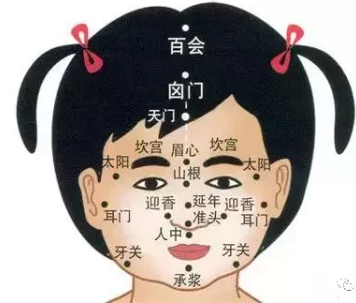
【Location】
A straight line is formed between the eyebrows to the front hairline.
【Operation】
Both thumbs are pushed straight alternately from bottom to top.
[Frequency]
30 to 50 times.
【Indications】
Fever, headache, cold, lethargy, irritability, etc.
【Clinical Application】
Pushing bamboo can clear the wind and relieve the surface, open the mind and awaken the brain, calm and calm the nerves. It is often used for external fever, headache and other symptoms, and is mostly used in combination with pushing the Kan palace and rubbing the sun; If you are frightened and restless, it is mostly used in combination with clearing the liver meridian and rubbing Baihui.
2. Kan Palace (eyebrow bow)
【Location】
From the brows, a horizontal line forms along the tip of the eyebrows.
【Operation】
The two thumbs are pushed from the center of the eyebrows to the tip of the eyebrows.
[Frequency]
30 to 50 times.
【Indications】
External fever, convulsions, headache, and red eyes.
【Clinical Application】
Tui Kan Gong can clear the wind and relieve the surface, awaken the brain and clear the eyes, and relieve headaches. It is often used for external fever and headache, more than pushing bamboo, rubbing the sun, etc.; If it is used to treat red and painful eyes, it is mostly used in combination with clearing the liver meridian, kneading Xiao Tianxin, Qinghe water, etc. It can also be used to push the posterior point for bleeding or use pinching to enhance the curative effect.
3. Yamane (mountain wind)
【Location】
Between the inner canths of the eyes.
【Operation】
Thumbnail pinching.
[Frequency]
3 to 5 times.
【Indications】
Shocks, convulsions.
【Clinical Application】
Pinching the roots of the mountain has the effect of opening the mind and calming the mind. For convulsions, coma and convulsions, it is mostly used in combination with pinching and pinching the old dragon. In addition to treating diseases, this acupoint is also used for diagnosis with longevity and zhuntou points, such as seeing green veins at the root of the mountain revealing spleen and stomach deficiency cold or convulsions.
4. Cheek car (jaw)
【Location】
In the masseter muscle above the mandible depression an inch below the ear.
【Operation】
Thumb press or middle finger rubbing.
[Frequency]
5 to 10 times.
【Indications】
The teeth are closed and the mouth and eyes are crooked.
【Clinical Application】
The cheek rub is mainly used for trismus, and if the mouth and eyes are crooked, the cheek rubbing car is mostly used.
5. Fontanelle
【Location】
The front hairline is two inches straight up, and the front bone is hollowed out.
【Operation】
Hold the child off with both hands, and push the two thumbs from the front hairline to the acupoint in rotation (when the fontanel is not closed, only push to the edge) to push the fontanel. Gently rub the fontanel with the tip of the thumb.
[Frequency]
Push or knead, 50 to 100 times each.
【Indications】
Headache, convulsions, dizziness, irritability, nasal congestion, bleeding, etc.
【Clinical Application】
Pushing and rubbing the fontanelle can calm the nerves and clear the orifices, more than headaches, convulsions, nasal congestion and other symptoms. The normal anterior cranium closes between 12 and 18 months after birth, so it is necessary to pay attention to the technique during clinical operation and not to press forcefully.
6. High bones behind the ears
【Location】
The back of the ear enters the depression under the high bone of the hairline.
【Operation】
Rub both thumbs or middle fingers.
[Frequency]
30 to 50 times.
【Indications】
Headache, convulsions, restlessness.
【Clinical Application】
Pushing the high bones behind the ears can relieve wind and relieve the surface. Treat colds and headaches. It is often used in conjunction with the Tuitian Gate and the Kan Palace. It can calm the mind and remove annoyance, and can treat dizziness and irritability.
7. Tianzhu (neck bone)
【Location】
The hairline at the back of the neck is in a straight line from the middle to the large vertebra point.
【Operation】
Use your thumb or index or middle finger to push the pillar from top to bottom, or use the edge of a porcelain spoon dipped in water to scrape from top to bottom.
[Frequency]
Push 100 to 500 times and scrape until there is mild blood stasis under the skin.
【Indications】
Nausea, vomiting, neck stiffness, fever, convulsions, sore throat, etc.
【Clinical Application】
Pushing and scraping the pillar can reduce adverse reversals and stop vomiting, dispel wind and dispel cold, and is mainly used to treat nausea, vomiting, external fever, neck stiffness and other symptoms. The treatment of vomiting is mostly combined with the horizontal stration pushing towards the plate door and kneading the middle navel. However, the use of merging is also effective, but it takes a lot of time to push that time; The treatment of external fever and neck strength is mostly used with taking the wind pool and kneading the two doors.